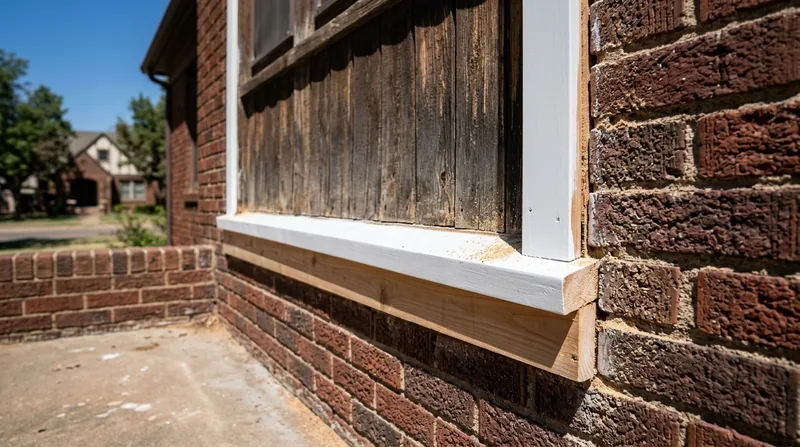




Sitting at 3,600 feet on the Llano Estacado, Amarillo's high plains climate seems dry enough to stop rot in its tracks. It doesn't. Snowmelt pools against sill plates each spring. Ice damming forces water into the lowest siding boards. Lawn sprinklers keep porch posts wet while the intense high-plains sun cracks the paint meant to protect them. Wood rot and dry rot repair in Amarillo isn't optional, it's a maintenance reality that catches most homeowners between their first freeze and the next hard thaw. We cut every soft section back to solid wood, treat what remains, and rebuild in rot-resistant lumber. The same carpenters handle every job, from diagnosis through completion, so you know what's actually happening to your home.
Why Wood Rot & Dry Rot Repair Matters in Amarillo's Seasonal Cycle
Dry Panhandle air slows rot but never stops it. The real damage drivers are snowmelt and ice damming that saturate sills and porch posts through winter, combined with the intense UV and low humidity that crack protective paint in summer. A sill plate that stays damp for three months can lose half its structural bearing capacity. Exterior trim boards on the south side of Craftsman homes in Plemons-Eakle or Wolflin can cup and split within two seasons if left unfinished. Porch posts on 1950s brick ranches in Olsen Park or Belmar are especially vulnerable because they sit low, catch runoff, and carry the load of an overhang.
- We identify soft wood by probing with a sharp tool, never by guesswork or fear tactics.
- We cut back to solid heartwood and measure the depth of loss so you understand what's actually there.
- We treat the remaining wood with a penetrating preservative to stop the rot's advance.
- We rebuild in pressure-treated lumber or naturally rot-resistant species like redwood or cedar.
- We prime and paint every surface before we leave so the repair lasts.
Catching rot early saves thousands in structural repair. Waiting until a joist or sill plate fails means floor joist and subfloor repair or worse.
Amarillo example: A 1920s Tudor in Plemons-Eakle had water pooling against the north-facing sill plate each spring. Three inches of the rim joist had softened. We cut it back, treated the remaining wood, and sistered in a new pressure-treated 2x8 bolted to the existing joist. Cost under $1,200. Waiting another year would have meant replacing the entire joist run and the subfloor above it.
How We Repair Wood Rot in Amarillo Homes: A Step-by-Step Approach
Every rot repair starts with honest diagnosis. We probe the suspect area with a sharp awl or screwdriver, feel how deep the softness runs, and measure the sound wood that remains. We don't use moisture meters or drama. We use our hands and eyes. If the wood is salvageable, we save it. If it's not, we replace it. Then we address the moisture source so it doesn't happen again.
- We locate all soft or discolored wood by probing and visual inspection under good light.
- We cut back to solid, dry heartwood using a sharp chisel or power tool, removing every soft fiber.
- We allow the exposed wood to dry for at least 48 hours before treatment (we work around weather).
- We apply a penetrating wood preservative to all exposed surfaces and let it cure per manufacturer specs.
- We rebuild missing sections in pressure-treated lumber, redwood, or cedar, fastened with stainless steel hardware.
- We prime all new wood with an exterior-grade primer and finish with quality paint or stain.
- We address the moisture source: redirecting downspout flow, repairing flashing, or improving drainage.
The result is a repair that stops the rot and lasts. For larger structural damage, we coordinate with beam replacement and load-bearing wall specialists or recommend a licensed structural engineer if the scope warrants it.
Local example: A porch post in Bushland had rot starting at the base where water from a downspout had been running for years. We cut the soft section back 8 inches, treated the remaining post, and sister-bolted a new pressure-treated 4x4 alongside it for the next 3 feet up. We redirected the downspout away from the post and sealed all fasteners. Total time: one day. Cost: $850. The post now carries its load safely for another 20 years.
Wood Rot Repair Methods: Which Approach Fits Your Home
| Approach | Description | Best for |
|---|---|---|
| Excavation and treatment | Remove soft wood back to sound heartwood, treat with preservative, leave exposed to dry and monitor. | Early-stage rot where the structure is not compromised and the member can be left open to air. |
| Partial sister-joist or sister-board | Bolt or lag-screw a new pressure-treated or rot-resistant member alongside the damaged one for partial-depth loss. | Sill plates, rim joists, and porch posts where the remaining wood is structurally sound but needs reinforcement. |
| Full member replacement | Remove and replace the entire damaged board, joist, or post with new pressure-treated or naturally rot-resistant wood. | Deep rot affecting more than 25 percent of the member's cross-section or load-bearing members in critical locations. |
| Epoxy consolidation (selective) | Fill voids in partially rotted wood with structural epoxy to restore some bearing capacity without full removal. | Decorative or non-structural trim where replacement would be visible and the wood has historical or aesthetic value. |
The right method depends on the wood species, the depth and extent of rot, the member's structural role, and whether the repair needs to be invisible or can be accepted as honest carpentry. We'll walk you through each option on site.
Wood Rot and Dry Rot Repair Cost in Amarillo: What to Expect
A straightforward rot repair on a sill plate, porch post, or trim board starts at around $650 and typically runs $800 to $1,500 depending on access, the depth of rot, and the linear feet of wood involved. A full joist replacement or large structural member can run $2,000 to $5,000 or more. The cost depends on how much sound wood remains, whether you can see and reach the damage easily, and whether the repair requires temporary bracing or permits.
Getting multiple estimates is smart because the difference between a $900 and a $1,400 quote often comes down to how much wood each carpenter thinks needs to come out. We'll show you what we're removing and why. We'll also tell you upfront if we think the damage is big enough to warrant a structural engineer's input, which is common for load-bearing members or major joist work.
For detailed pricing and to understand how your specific job factors into the range, visit our pricing page or call us at (806) 484-0557 for a free estimate. We'll come out, probe the wood, explain what we find, and give you a firm number before we start.
What to Look for When Hiring a Wood Rot Repair Carpenter Near Me in Amarillo
You want a carpenter who can explain what rot actually is, show you where it is, and tell you honestly whether repair is enough or replacement is the real answer. Red flags: contractors who push replacement without probing, who quote over the phone, or who talk about rot like it's a catastrophe rather than a building-material failure. The best carpenter in Amarillo is the one who does the work himself, not a franchise that sends a different crew each time.
Check that your carpenter is fully insured and ask to see proof. Ask for references from jobs done in the past two years in Amarillo or nearby towns like Canyon, Bushland, or Timbercreek Canyon. If the repair touches a load-bearing member or requires moving framing, ask whether a permit is needed and whether the carpenter will coordinate with your local building department. If you're in a historic district or an HOA community, verify that the repair method and materials meet those rules before work starts.
Get at least two estimates so you can compare approach and price. A cheap estimate often means the carpenter is cutting corners or hasn't looked closely enough. A high estimate might include unnecessary replacement. The middle estimate from a carpenter who can explain his reasoning is usually the smartest choice.
Ready to move forward? Contact us for a free estimate or call (806) 484-0557. We'll come out, probe the wood, explain what we find, and give you a price with no obligation to book.
Wood Rot & Dry Rot Repair in Amarillo: Pricing Guide
| Service | Price | Details |
|---|---|---|
| Sill plate or trim board rot repair | Starting at $650 | Includes probing, excavation to sound wood, treatment, and partial rebuild in pressure-treated lumber up to 10 linear feet |
| Porch post or structural member repair | Starting at $1,100 | Includes sister-bolting, full member replacement if needed, and structural fastening for posts carrying roof or deck load |
| Floor joist or subfloor rot repair | Starting at $1,800 | Includes temporary bracing if needed, removal of soft wood, treatment, and replacement with pressure-treated lumber and stainless fasteners |
| Large or multi-member structural rot repair | On estimate | Requires on-site inspection to assess extent of damage, load-bearing role, access constraints, and whether engineering or permits are needed |
| Travel and mobilization | Included | No separate charge for Amarillo and surrounding service areas within our regular territory |
| Free estimate | No charge | Response within 24 hours at (806) 484-0557; we probe the wood, show you what we find, and quote a firm price |
Indicative pricing, the exact cost depends on square footage, finish, and site access. Free personalized estimate within 24h at (806) 484-0557.


